

Postcard from Cairo, Egypt
[A tale of two museums.]
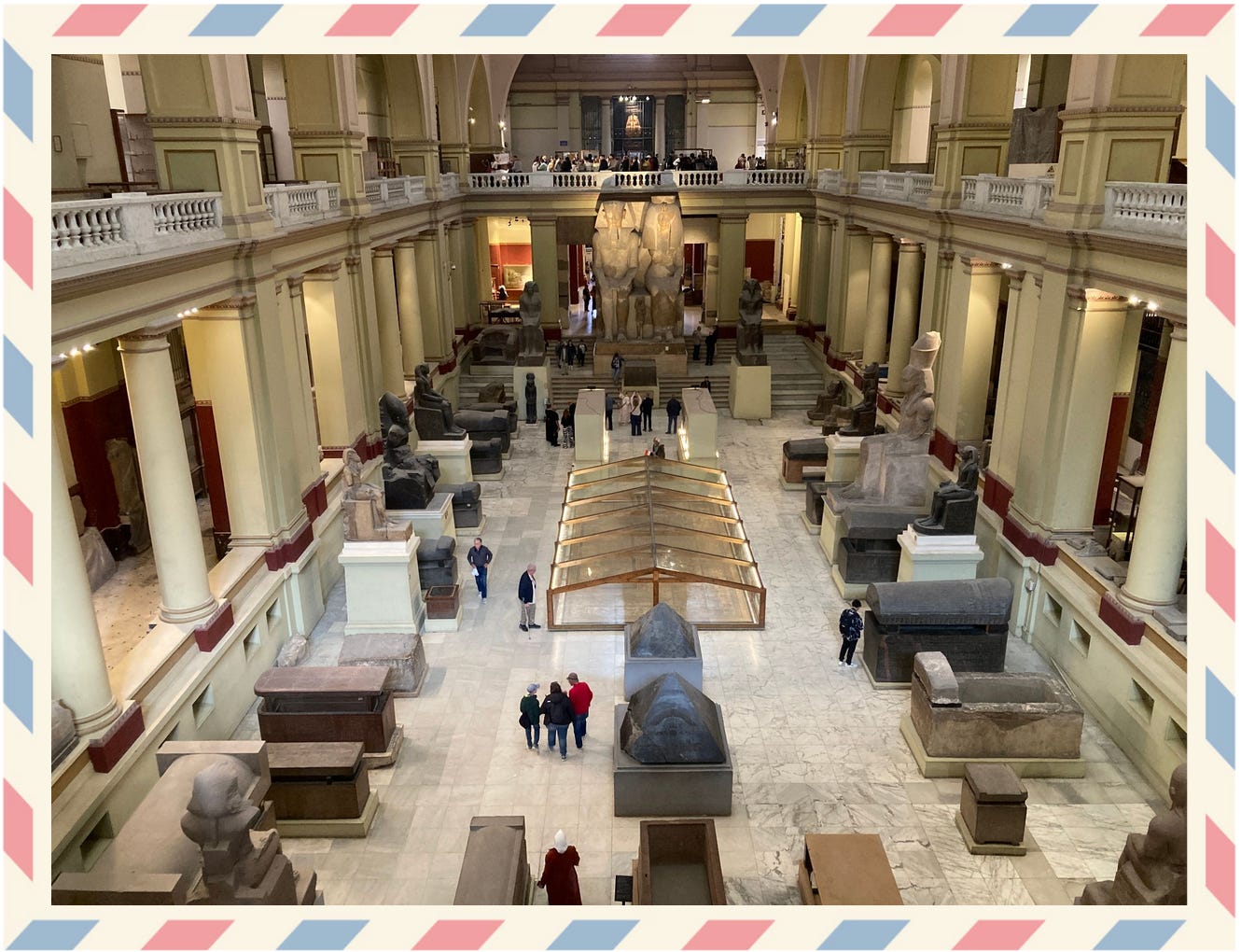
Give me any museum. Let me wander and lose track of time long enough to briefly live there, like E.L. Konigburg’s wonderful book about running away from home and living in the Met.
Even when my feet hurt, I love them: shiny marvels of architectural genius like the Acropolis Museum, grand old dames that wear us out like the Prada, and forgotten backrooms like the one in Luang Prabang, Laos, where I had hundreds of cobwebbed Buddhas all to myself in ponderous silence.
So you won’t be surprised to hear that I loved both the sparkling Grand Egyptian Museum (GEM) in Giza that literally smells new and isn’t even completely open, and the dusty, enormous, 1897 Egyptian Museum in downtown Cairo.
I thought we might need to choose. Many travelers do. You’ve just seen the Giza pyramids, and now where to you go? We looked up where King Tutankhamun’s death mask is these days and read conflicting reports—is it still in the Egyptian Museum or has it been moved to the GEM already?
The GEM seems like the important, expansive setting that ancient Egypt’s great treasures deserve. The building, with multiple cafes and gift shops and spotless bathrooms, sweeps you up, wowing you with perfectly framed views of the pyramids from geometrically dazzling windows. The artifacts are displayed in highly logical chronology, although the lighting, I regret to tell you, sometimes casts weird shadows on objects, showing off the building better than the treasures. I’m not complaining, though; it’s a splendid experience to stroll through the GEM.
But King Tut’s mask and his other tomb treasures, as of now, remain in the Egyptian Museum in the heart of Cairo. So off we went. If they’d already moved it, we’d have gone to the GEM only, most likely.
We would have missed the real deal.
The Egyptian Museum is a mess. Rows of topical rooms give off a whiff of organization, but countless marvels are plopped just anywhere. Many interpretive signs are yellowed treasures unto themselves, typewritten perhaps in the 1920s with dates corrected in ink. I saw two statues mysteriously labeled only in Braille. In one room, with no interpretive signs anywhere, a slab of stone carved with ancient hieroglyphs was balanced on a warped wooden pallet on the floor.
Then I bumped into a mummy. I don’t mean that metaphorically. I skimmed around a display to avoid a tour group, and found myself against a mummy’s glass case in the corridor, as if a couple of workers had been been in the middle of moving it, paused for a smoke break, and forgot to come back.
I never did find the papyrus remains of the Diary of Merer, which I’d read were in there somewhere. But I found other gorgeous scraps of ancient papyri, dolls with beaded hair, gold upon gold, pottery of all kinds, statues with staring eyes of precious stones, and thousands more things—including King Tutankhamun’s mask in a small side room. I didn’t know until I stood before it how beautiful it is: the exquisite rows of colored glass, the stones, the golden face calmly receiving our wonderment. It was the highlight of the Egyptian Museum for Justin and me.
But even when it’s moved to the GEM—please, go to the Egyptian Museum. See the GEM for curated precision, where the past is linear and the future looks pretty under control, too. Then go to the Egyptian Museum and get lost. See that our human story, despite valiant attempts to explain it to ourselves, is an infuriating, riotous abundance. And the future? It appears we don’t have a clue. Really seeing our own past—full of astounding beauty, but it’s not pretty—may be our best, last hope.
We only went to the museum in Cairo and I was glad we had a guide because you could get lost for days in there. Whole rooms filled with replicas of sailing ships! If we had an extra day, we would have gone back and just wandered
I’m sending you waves of envy, Launa, for being able to go through the Egyptian Museum. Your depiction reminds me of our experience at The Hermitage in St. Petersburg. Rooms upon rooms of old masters, the best of The West that successive czars could afford (which was everything they wanted). And right above the temperature and humidity controls? An open window, so the docent, seated there for the afternoon, could enjoy the fresh air. I love those sorts of museums!